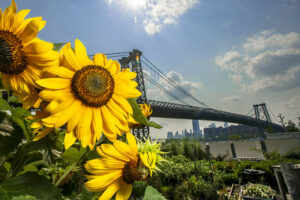
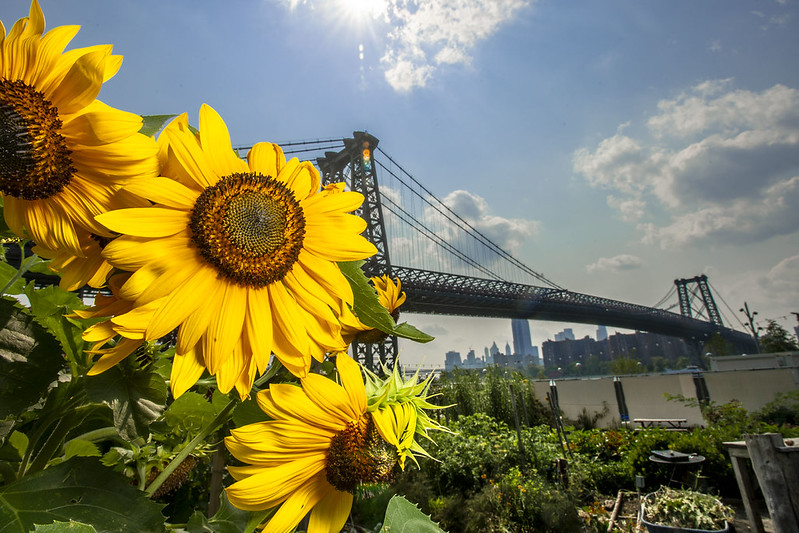
Sunflowers encourage pollination from the bees and other insects at the North Brooklyn Farm (NBF) in the shadow of the Williamsburg Bridge is a site for agritourism where crops are grown. New York, USA in 2018. Photo by Preston Keres/USDA under Public Domain license.
Humanity is heavily reliant on pollinators and needs to protect them to safeguard their health and wellbeing. In the first in our World Food Day series 2026, Mairead Redmond follows the role of the mighty pollinators and the rising influence of ultra-processed food.
From birds, bats, bees, butterflies, beetles and other small mammals, pollinators visit flowers to drink nectar, feed off pollen and transport pollen grains from the male part of a flower to the female part, allowing fertilisation and seed production.
This pollinating process is a critical part of global food and ecological systems because it allows over 80% of wild flowering plants to reproduce, produce seeds, and maintain genetic diversity, forming the foundation for healthy food webs, stable soils, and resilient natural habitats.
Despite their importance, the pollination process often goes unnoticed as it occurs in silence, and underneath our feet. Yet, many nutrient-rich foods, like fruits and vegetables, would likely go extinct without pollination. The Food and Agriculture Organisation (FAO) echo the essential role of pollinators by stating that:
Pollinators have been essential for millions of years, not only for the production of nutrient-rich foods but also for maintaining vibrant ecosystems.’
Despite the deep reciprocal relationship between people and pollinators, there are numerous pollinator populations at risk of extinction locally, and globally. The downward trend in pollinator populations is mainly driven by habitat loss, intensive farming practices, changes in weather patterns and the excessive use of agrochemicals, such as pesticides and fertilisers.
The next feature in the World Food Day series will detail how the farming industry can break free from the fossil-fuelled toxic trifecta: Fossil fuel energy, synthetic pesticides, and synthetic fertilisers, and move towards organic farming to create better food security, and climate resilience. The next section will explore the risks and vulnerabilities of a decline in pollinator populations.
Identifying the link between pollinators decline and hidden hunger
Declining pollinator populations risk causing ‘hidden hunger’ and micronutrient deficiencies by reducing the supply of essential vitamins. Hidden hunger is a chronic lack of essential vitamins and minerals, even when a person consumes enough daily calories. It is called ‘hidden’ because it lacks the obvious physical signs of acute starvation, yet it quietly harms health, growth, and immune function.
A rapid decline in pollinators can adversely affect the stability of food and ecological systems. The latest State of food security and nutrition in the world report 2026 presents current food insecurity levels globally by the UN Food and Agriculture agency (FAO):
- About 2.1 billion people in the world – 25.8 percent of the global population – are estimated to have been moderately or severely food insecure in 2025.
- In 2025, more than half the population of Africa (56.6 percent) was moderately or severely food insecure, compared to 20.3 percent in Asia, 22.9 percent in Latin America and the Caribbean, and 8.7 percent in Northern America and Europe.
Additionally, research published in 2021 highlights research from 200 countries which found that agricultural productivity from 87 out of 115 of the leading global food crops are dependent on animal pollination. Hence, food security and the supply of nutrient rich foods are deeply intertwined with the health of pollinator populations.
Exploring the influence and impact of ultra-processed foods on food quality standards
The nutritional value of food can significantly vary and can be highly influenced by the level of processing.
For example, ultra-processed foods (UPF) are characterised by their industrial processing and lack of whole foods, such as fruit, vegetables and grains. UPFs are defined as:
Industrial formulations typically with 5 or more and usually many ingredients. Besides salt, sugar, oils, and fats, ingredients of ultra-processed foods include food substances not commonly used in culinary preparations, such as modified starches, and hydrogenated oils, and also, additives, including artificial sweeteners, flavourings and emulsifiers, that imitate the taste and texture of foods prepared from scratch.
– Michael J Gibney writing in the journal Current Developments in Nutrition in 2019, who also worked at the Institute of Food and Health, University College Dublin).
Examples of UPFs reported in the UK newspaper The Guardian, include mass-produced packaged unhealthy snacks, fizzy drinks, sugary breakfast cereals, ready-to-eat frozen meals, and processed meats like hot dogs or sausages.
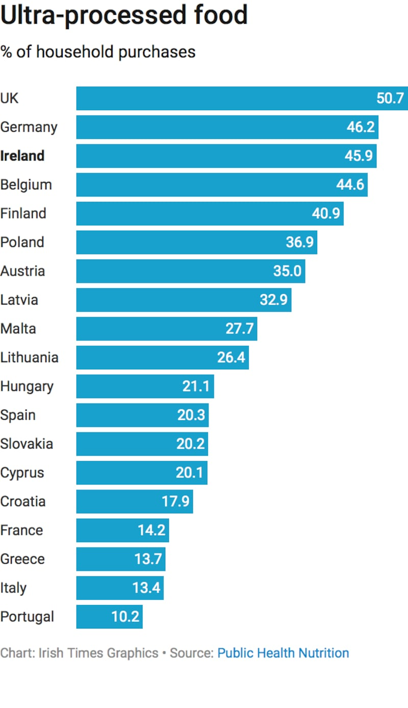
In 2018 UPF’s were reported as making up almost 45% of Irish household purchases on average, making Ireland one of the largest consumers of UPFs in Europe as depicted in the graph below.
A number of global trends paint a challenging picture:
- Reporting their findings in the Public Health Nutrition journal in 2019, a team of researchers in Brazil and Canada found that ultra-processed foods are dominating diets in many countries and already make up more than half of the total dietary energy consumed in high-income countries such as the USA, Canada and the UK and between one-fifth and one-third of total dietary energy in middle-income countries such as Brazil, Mexico and Chile.
- The largest review of ultra-processed food found that UPFs are directly linked to 32 harmful effects to health, including a higher risk of heart disease, cancer, type 2 diabetes, adverse mental health and early death.
- More than 1 billion people live with obesity and a further 2 billion are overweight, with UPFs being a staple in the diets of the countries with high obesity, and overweight statistic.
- Litigation is being used by food companies as a long term strategy to stop governments from taking action. Tedros Adhanom Ghebreyesus, director general of the World Health Organization has said ‘Litigation has been used to oppose or weaken public health measures on obesity and unhealthy diets…These delays cost countries billions in healthcare and legal expenses and create a regulatory chill that deters governments from adopting vital protections.’
Taken together, UPFs contribute to hidden hunger as they are typically calorie dense but not filling and often lacking in nutritional value.
In contrast to UPFs, natural foods like fruits, vegetables, and grains, are high in nutritional value, and minimally processed foods that have undergone simple changes, like blending and freezing, can also contribute to a nutrient rich diet.
Pollinators play an important role in the creation of many nutrient rich foods, and must be protected. To reverse the poor treatment of bees and other pollinators, countries must harness the conditions that enables bees, and other pollinators, to flourish and thrive across the landscape.
A Global call to protect the pollinators
Humanity is heavily reliant on pollinators and needs to protect them to safeguard their health and wellbeing.
To protect pollinators, we must understand the conditions they rely upon for survival. Pollinators have needs, like people, and require a steady supply of diverse flowers that are rich in nectar and pollen. They also need an environment free from harmful chemicals, and pollutants to effectively support agricultural and ecological processes.
South Africa is a leading example of a nation that has an impressive diversity of pollinators matched by an equally extraordinary plant diversity. Bees, flies, beetles, butterflies, moths, wasps, ants, and other pollinating insects, all contribute to the movement of pollen between flowers, and the enhancement of their local ecological system. The country is renowned as one of the world’s biodiversity hotspots.
Legal approaches to Nature, and Pollinators
Ecuador is the first country to assign legal rights to nature, and this legislation helps to protect biodiversity and supports the needs of pollinators.
In 2026, Peru became the first country to assign legal protections to stingless bees which is a key pollinator in supporting Peru’s food supply and ecological systems.
According to bee experts at the Food and Agriculture Organization (FAO) of the United Nations, a third of the world’s food production depends on bees. Due to their impacts, bees are recognised as the most important pollinators on the planet.
Peru’s legal approach to key pollinators could be applied in Ireland, and other countries. The following video depicts how legal rights were assigned to bees in Peru:
Ireland's call to protect pollinators
In Ireland, pollinators, like bees, moths, and hoverflies provide important pollination services, helping fertilise many flowers, crops, and wild plants. Bees are regarded as the most important pollinator of crops and native plant species on the island of Ireland.
A recent study by the Department of the Environment estimates that bees are worth €85 million a year to the Irish economy.
Without pollinators, food security and ecological stability in Ireland hangs in the balance.
A diversity of landscape features, hedgerows for bumblebees and ditches for hoverflies are essential for promoting a diversity of pollinators across the landscape. The All-Ireland Pollinator Plan is a framework bringing together different sectors to create a landscape where pollinators can thrive again.
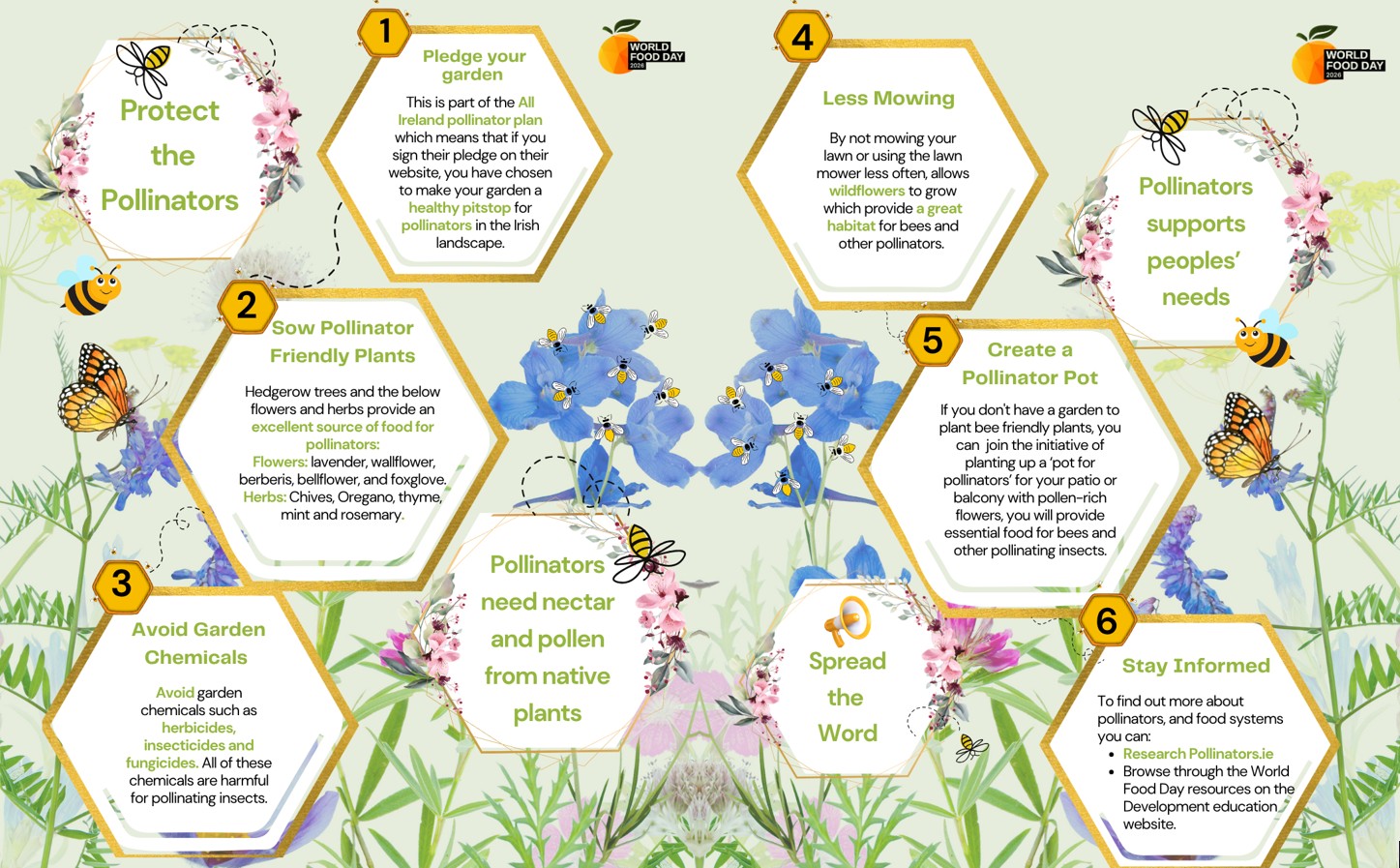
Here are the All-Ireland Pollinator Plan’s top evidence-based actions to support pollinators:
- The next feature in the World Food Day series explores the farming industry’s fossil-fuelled toxic trifecta, namely: fossil fuel energy, synthetic pesticides, and synthetic fertilisers.
- Explore the third part in our World Food series explores the harmful effects of monocultures and small groups of firms with majority control in the agriculture and food industry.
Starter Teaching Activities
Primary Activities
- Draw a garden that includes the conditions that would enable pollinators to thrive (steady supply of flowers for nectar and pollen, clean water for hydration and cooling the hive, and safe, dry shelter for nesting or hiving)
- Compile a list of food that required a pollinator, and create a starter, main and desert with food supported by pollinators.
- Imagine you are a farmer, what farming practices would you implement to support pollinators on the farm? Discuss in pairs for 5 minutes and open it up to the wider classroom for greater discussion.
Post Primary Activities
- Imagine you are a politician and you had to introduce laws that would support pollinators, discuss in pairs about what laws you’d introduce for 5 minutes and open it up to the wider classroom for greater discussion.
- Write a letter to a politician about the importance of introducing legislation that supports biodiversity and pollinators (include links to agriculture, hunger, and ecology).
- Draw an outline of your hometown with additionally supports for pollinators, and biodiversity. Think about what supports are already in place and build on them.
This World Food Day series is brought to you by Concern Worldwide, Scoilnet, Self Help Africa and developmenteducation.ie
More on developmenteducation.ie